


Welcome to custom chocolate mold diy part 1 — the first episode in Fordee’s multi-part series on how to make custom chocolate molds for cannabis edibles at home. This part covers everything before the silicone: modeling the blank in 3D software, printing it on a resin or FDM printer, and sealing it for the pour. If you are looking for how to make molds for edibles from scratch, this is where you start.
Custom Chocolate Mold DIY Part 1: What Is a Mold Blank?
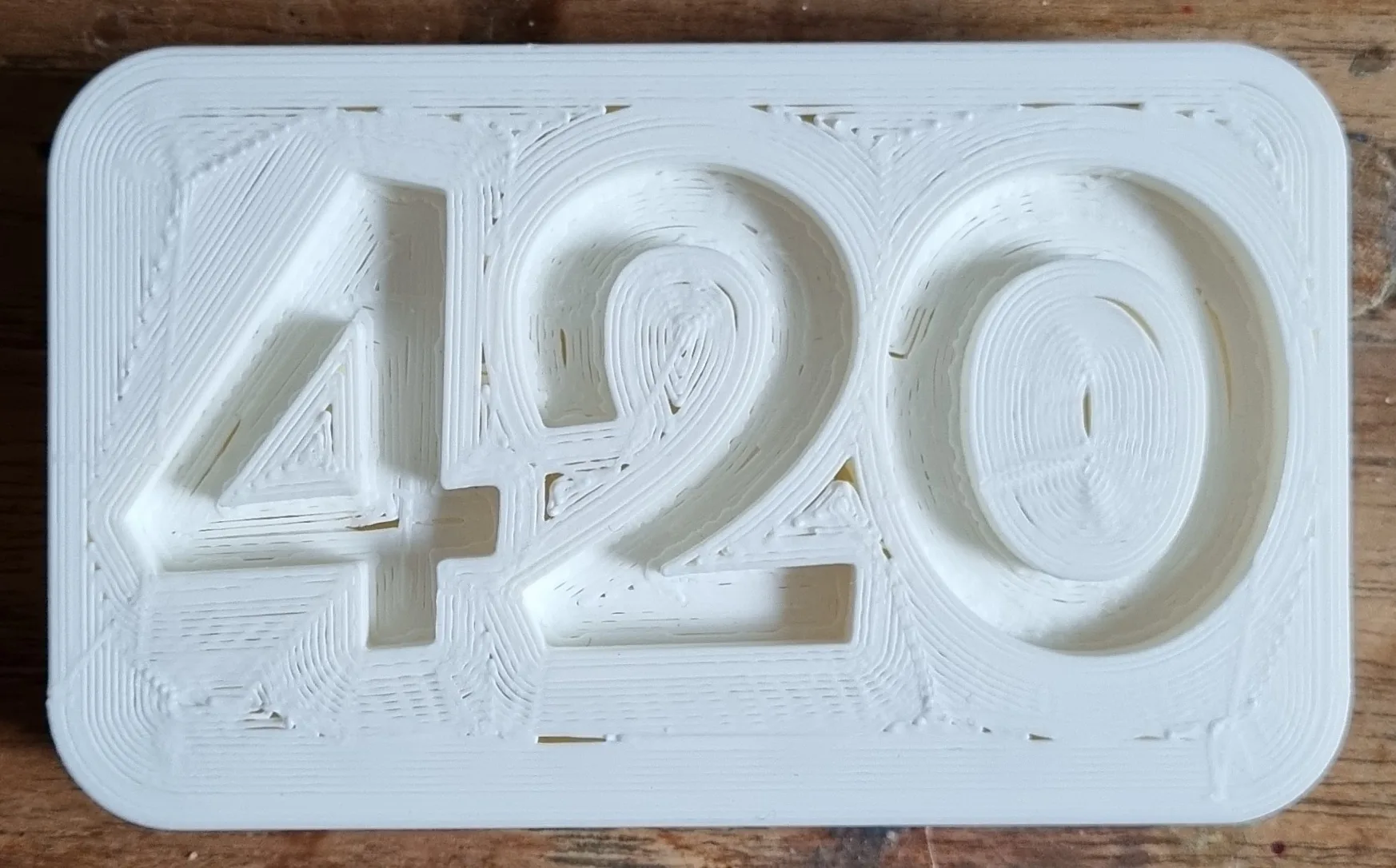
A mold blank is the positive master object — the physical shape you want your chocolate to take. The silicone poured around it in Part 2 picks up every surface detail, creating the negative cavity you pour chocolate into. For this custom chocolate mold diy part 1 project the blank is a 10×5 cm rectangular bar with “420” subtracted from the face — the perfect shape for infused cannabis chocolate bars.
How to Make Custom Chocolate Molds: 9-Step 3D Design
Here is how to make custom chocolate molds starting from scratch in Cinema 4D. The same technique works in Blender (free) or any other 3D app that supports volumetric modeling:
- Open Project Settings (Cmd+D / Ctrl+D) and change scale from centimetres to millimetres.
- Create a Rectangular Spline — width 100 mm, height 50 mm. Enable corner rounding and set radius to 7 mm for a classic candy bar edge.
- Apply an Extrude to the spline — set depth to 10 mm (1 cm).
- Create a Text Spline — type “420”, set height to 50 mm. Center it on the rectangle using Tools → Arrange Objects → Center.
- Apply a second Extrude to the text — set depth to 5 mm.
- Create a Volume Builder. Drag the rectangle extrude in as the base layer (Union) and the text extrude in above it set to Subtract. This hollows the “420” from the bar face.
- Add a Smooth Layer inside the Volume Builder — voxel distance 3, iterations 2. Drop the main voxel size to 0.05–0.1 mm for detail.
- Add a Volume Mesher — drag the Builder in. Set Adaptive to 1% to shrink file size. Press C to make it an editable polygon object.
- Export as STL (File → Export → STL) — confirm scale is millimetres and save.
3D Printed Chocolate Mold: FDM vs Resin
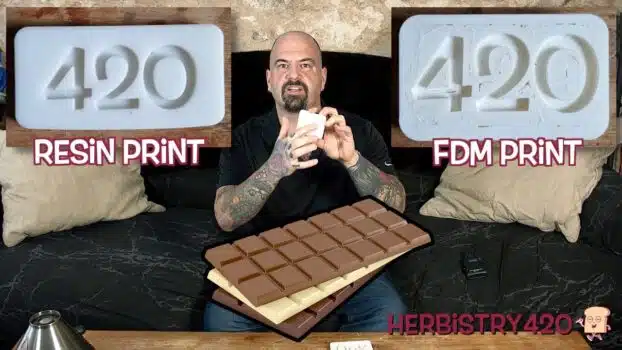
For a 3D printed chocolate mold blank, resin is the better choice. Resin printers produce smoother surfaces with finer detail than FDM — important because every surface imperfection transfers to the silicone and then to your chocolate. FDM blanks often have small layer gaps or surface pitting that require sanding before use. A resin 3D printed chocolate mold blank for this 10×5 cm design prints in under two hours on most consumer MSLA printers.
For slicing, use ChituBox (free) or equivalent. Import your STL, rotate the model 45° for best print quality, add auto-supports, slice, and export to your memory card.
How to Make Molds for Edibles: Sealing the Blank
Before any silicone contacts your blank, you need to seal it. Here is how to make molds for edibles safely — bare resin can inhibit platinum-cure silicone from setting properly, leaving a sticky surface that ruins the mold. Spray the finished blank on all sides with a clear varnish. Two light coats and a 24-hour dry time are enough. Once sealed, the blank is ready for the silicone box and pour covered in Part 2.
Custom Edible Molds: What Comes Next in Part 2
Part 1 gives you a sealed, print-perfect blank — but the custom edible molds themselves get made in Part 2. That episode covers building the acetate walls around the blank, mixing and pouring food-grade platinum silicone, curing for 24 hours, and pulling the finished mold to test with cannabis-infused chocolate. Watch it here: Custom Chocolate Mold DIY Part 2.
Frequently Asked Questions
Do I need Cinema 4D for this custom chocolate mold diy part 1 project?
No. Blender is free and uses the same volumetric modeling logic. The menu names differ but the workflow — spline → extrude → volume builder → subtract text → export STL — is identical in any modern 3D app.
Can I use an FDM printer for the mold blank?
Yes, but expect more post-processing. FDM blanks may need sanding before the silicone pour. A resin 3D printed chocolate mold blank gives the silicone more faithful surface detail and requires the least cleanup.
Why varnish the blank before the silicone pour?
Bare resin inhibits platinum-cure silicone from curing. Varnishing seals the surface and ensures the silicone sets cleanly and releases without sticking.
Is this method good for custom edible molds beyond chocolate?
Absolutely. The same blank-and-silicone method works for gummies, hard candy, ice, butter molds, and any other custom edible molds you want to make. The 3D design is fully customizable — change the shape, text, or dimensions to match whatever edible format you are working with.
References
- Stereolithography (Resin Printing) — Wikipedia
- Blender — Free 3D Modeling Software
- Chocolate Guide — Healthline
Learn More on Herbistry420
Purchase Links
🛒 Cinema 4D – https://www.maxon.net/en/cinema-4d
🛒 Blender – https://www.blender.org/
🛒 Anycubic Photon Mono 4k Resin Printer – https://amzn.to/3WRDURN
🛒 Anycubic 3D Printer Resin (White) – https://amzn.to/3DV9LZd
🛒 Anycubic Wash and Cure Station – https://amzn.to/3tC3vkF
Save 5% on your POT by Noids by using coupon code herbistry420
🛒 To pick up the POT by Noids please visit – https://bit.ly/4orC6Nf
Support Herbistry420 by visiting our Cannabis Apparel Store, we have t-shirts, hoodies, pants, towels, you name it!
Note: Some links are affiliate links. Purchases through these links support the channel at no extra cost to you.
Add comment